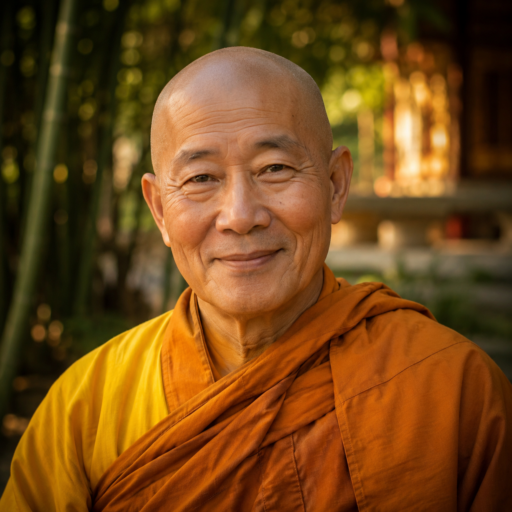
People often ask me what a Buddhist monk actually does in the morning.
They imagine candles, hours of meditation, deep chanting in a temple.
The truth is much smaller, much older, and much easier to copy. A monk
who has trained for forty years does perhaps six things before noon, and
none of them require a robe or a temple. They require only that you
choose how the day begins, instead of letting the day choose for you.
This is the morning I have practiced for most of my adult life. It is
the morning I taught to my own students in the monastery, and it is the
morning I now teach to artists and software engineers and tired parents
who write me letters from cities I have never seen. Adopt one of these
six. Then another. The order matters less than the consistency.
1. Open Your Eyes Without Reaching for Anything
The single most common mistake in modern morning life is to wake up
and immediately pick up the phone. A phone touched in the first thirty
seconds of consciousness teaches the brain that information arrives
faster than awareness. From that moment, the nervous system spends the
rest of the day catching up.
Instead, open your eyes. Notice the ceiling. Notice the temperature of
the room. Notice whether your shoulders are already braced. Stay there
for sixty seconds. The morning does not start when the world arrives. It
starts when you do.
2. Sit on the Floor for Five Minutes
Before your feet carry you anywhere, sit on the floor. Cross-legged,
or kneeling, or with your knees folded under you, whichever your hips
allow today. The shape does not matter. The ground does.
Modern chairs and beds hold your body in a small, soft tension. The
floor returns the spine to its oldest posture. Five minutes on the floor,
eyes closed, palms up. Do not try to meditate. Do not try to clear your
mind. Simply allow your body to remember that it is older than every
problem it carries.
3. Warm Water Before Anything Else
The first liquid your body meets in the morning programs the entire
day. Cold water shocks the heart. Coffee asks the adrenal system for a
favor before it has stretched. Warm water, sipped slowly, is a hand on
the shoulder of every organ that worked while you slept.
In traditional Chinese medicine, warm water is considered the gentlest
medicine in the cabinet. It is free. It is older than every supplement
in your kitchen. Begin with a single cup, slowly drunk, before anything
else enters your body.
4. Take Three Breaths Before You Speak
My teacher in Burma gave me one instruction, and one only. Before the
first word of any day, take three breaths. I followed his instruction
for forty years before I fully understood what he had handed me.
The first word you speak sets the tone for every word after it. If
you wake up and immediately speak from a tense body, the rest of the
day will be spent trying to recover that ground. If you wake up and
your first word comes after three breaths, you will spend the rest of
the day teaching everyone around you, without any of them knowing, what
calm sounds like.
The breath itself is simple. Inhale four. Hold one. Exhale eight. Do
this three times. Then speak.
5. Walk Outside for Ten Minutes Without Sound
Before nine in the morning, step outside for a ten minute walk
without any sound entering your ears. No podcast. No music. No phone
call. Just the walk, the sky, your breath, and your feet.
Ten minutes of morning light, ten minutes of slow movement, and ten
minutes without consuming someone else’s voice. This is one of the
oldest forms of medicine the body recognizes. It tells the circadian
rhythm where you are in the day. It loosens the spine. It gives the
mind a chance to be alone with itself for the first time in many
years.
6. Speak Three Sentences of Gratitude Before Breakfast
Before food enters your body, speak three sentences out loud. Not in
your head. Out loud. The body listens differently when the mouth is
involved.
The sentences should be small. Thank you for this new day. Thank you
for this breath. Thank you for the people who are still in my life. Or
whatever feels honest. The content matters less than the act of
speaking. Gratitude, spoken in the morning, settles the nervous system
in a way that no app or supplement can replicate.
This is the closest thing the monks have to a daily prayer. It is
not religious. It is biological. The body that begins the day with
gratitude is the body that ends the day less exhausted.
Putting Them Together
If you adopt all six, your first hour will look like this:
- Sixty seconds of eyes open, no reaching.
- Five minutes on the floor.
- A cup of warm water.
- Three breaths before the first word.
- Ten minutes walking outside without sound.
- Three sentences of gratitude before breakfast.
That is twenty five minutes. Less than the time most people spend
scrolling in bed. And these twenty five minutes pay you back for the
remaining twenty three hours of your day, every day, for as long as you
keep them.
Do not adopt all six at once. The mind cannot absorb six new
instructions in one week. Choose one. Use it for seven days. Add a second
in week two. By month three you will have a different morning, and a
different life.
Quick answers
- QDo I have to wake up early to do this morning routine?
- ANo. The routine is not about an hour on the clock. It is about
the first hour after you open your eyes. If that is at five in the
morning, do it then. If it is at nine, do it then. The body does not
measure time, it measures order. - QWhat if I work the night shift?
- AApply the routine to your own morning, whenever that arrives. The
practices work for the body, not for the clock. A nurse coming home at
seven in the morning still has a morning when they wake from their
sleep at three in the afternoon. - QI have small children. The first hour is not mine.
- AThen carve out ten minutes within it. Sit on the floor while you
watch them play. Drink warm water in the kitchen before you make their
breakfast. The practices are flexible. The intention is what
matters. - QIs this religious?
- ANo. None of these practices require any belief. Buddhist monks
codified them, but a farmer or a factory worker in any century could
have given you the same advice. The body recognizes them whether or
not you believe in anything. - QWhere can I read more?
- AMy e-book, The Quiet Path, contains the full thirty day
morning practice, with daily check-ins and small adjustments. You can
read about it on the
homepage.
Begin the practice tomorrow morning.
Drop your email below and receive 7 Rituals for Inner Calm, the small booklet I give every new student in their first week. One ritual a morning. By Sunday evening the noise will have gentled.
Free PDF. No subscription. One-click unsubscribe in every email.
Important notice. This article is for informational and educational purposes only. It is not medical advice, a diagnosis, or treatment. Consult a licensed healthcare professional before making significant changes to your sleep, diet, exercise or wellness routine.